
AI tax software for tax professionals
Short answer
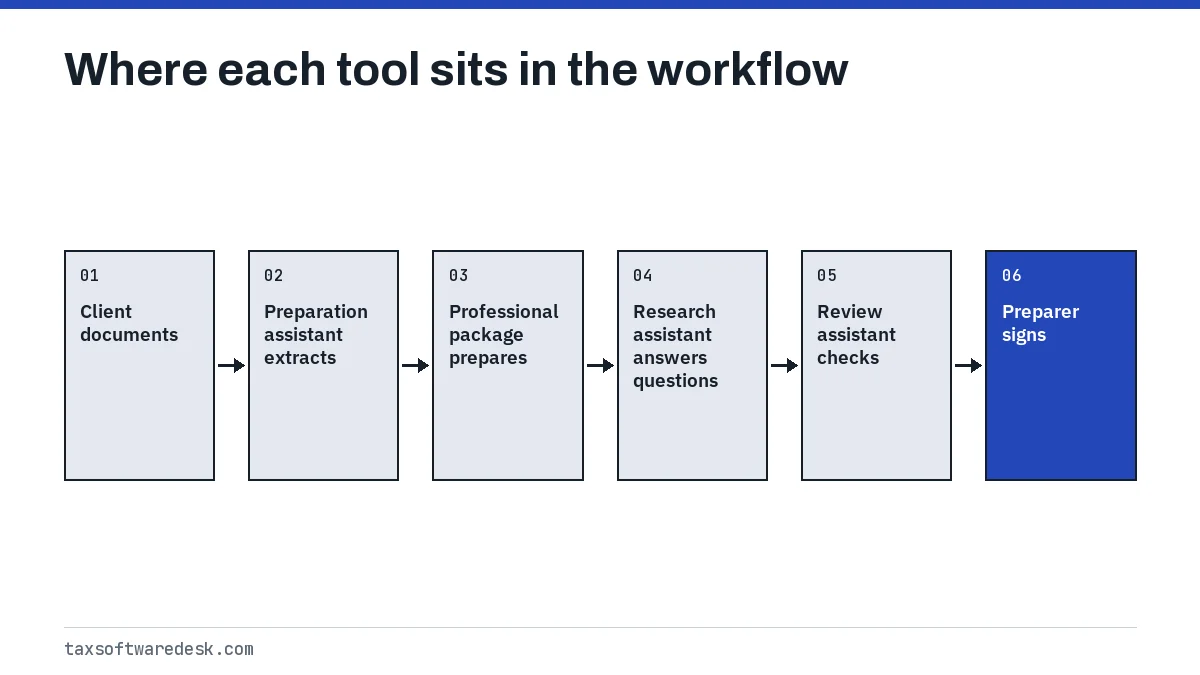
Professional AI tax tools split into three jobs: research assistants that answer with citations, preparation assistants that read documents into a return, and review assistants that check a finished return. They sit alongside Lacerte, ProSeries, UltraTax and Drake rather than replacing them, and none of them moves responsibility off the preparer who signs.
- 01Firms already using generative AI
- 34%, with a further 47% planning or considering
- 02Three categories
- Research, preparation, review
- 03What to demand
- Citations you can open
- 04Who signs
- The preparer, unchanged
What counts as AI tax software for professionals?
Three different products get called the same thing, none of them the AI built into consumer filing software, and buying the wrong one is the most common mistake.
| Category | What it does | What good looks like |
|---|---|---|
| Research assistant | Answers a technical question from tax authority | Every answer carries citations you can open |
| Preparation assistant | Reads documents and populates the return | Accurate extraction, clear audit trail |
| Review assistant | Checks a finished return for problems | Flags with reasons, not just scores |
Research is where the market is most mature, because the output is a memo a human reads. Preparation and review touch the return itself, which raises the stakes on accuracy.
How widely are firms actually using this?
Wider than the scepticism in the profession suggests. Thomson Reuters Institute's 2026 report on AI in professional services found 34% of tax firms already using generative AI in their work, with a further 47% either planning to use or considering a tool.
That leaves under a fifth of firms with no position at all, which is worth knowing if you are deciding whether this is early or late.
Which tools come up most
Naming products in a moving market dates quickly, so treat this as the shape of the field rather than a ranking.
- TaxGPT is an assistant aimed at preparers, covering cited research, document analysis, return review and client management. It reports more than 80,000 users and over 650,000 questions asked.
- Blue J and Thomson Reuters CoCounsel lead on research, and are the names that come up when practitioners specify that they need answers with citations.
- Keeper sits on the bookkeeping-to-tax workflow for smaller firms and for freelancers.
- Intuit's own AI is built into the consumer products, and Intuit has extended AI into its professional line as well.
None of these is a filing platform. Your return still goes out through Lacerte, ProSeries, UltraTax, Drake or whichever package your firm uses, and the AI tool sits beside it.
Why citations are the whole test
A general model can produce a confident answer with an invented citation, and invented tax authority is the failure mode that ends careers rather than afternoons.
A research tool built on a publisher's own content can point at the actual paragraph. That is the difference worth paying for, and it is the question to ask in a demonstration: not whether the tool answers well, but whether you can open what it cites and find the answer there.
Where AI is weakest for preparers
The same places a general chatbot gets tax questions wrong for everyone else, magnified because your clients' returns are more complicated than the average consumer's.
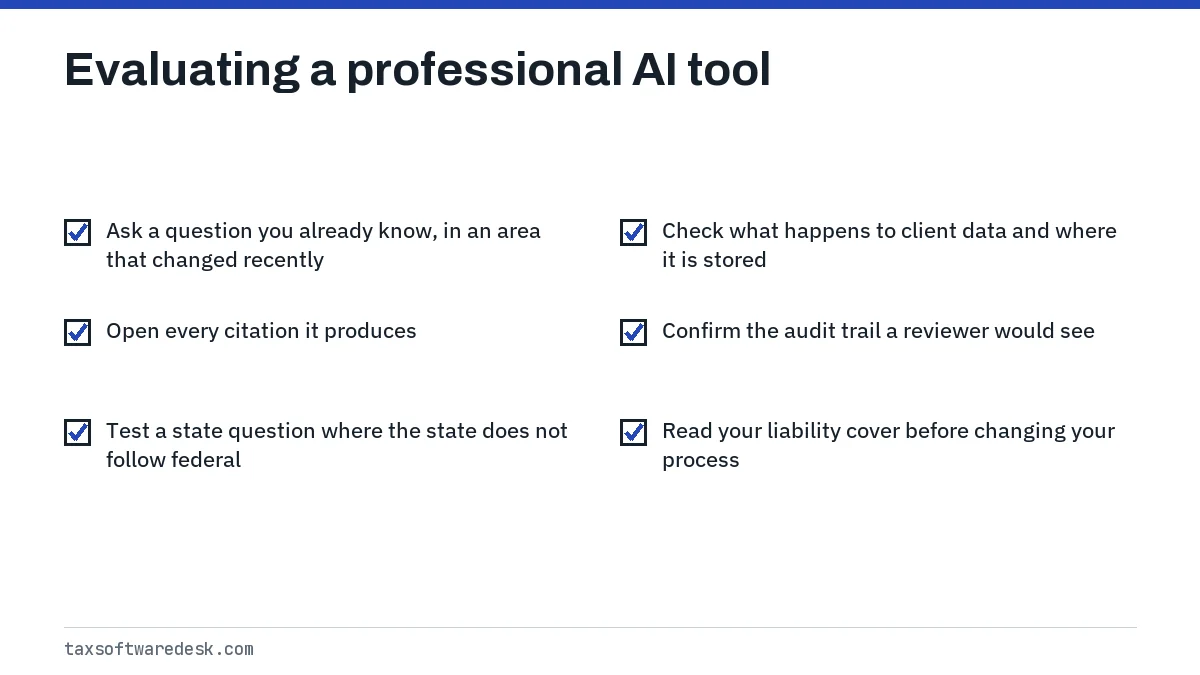
- Recent law. Tax year 2026 brings the charitable deduction's 0.5% of AGI floor, the limitation replacing the repealed Pease limitation, and a second year of the Schedule 1-A deductions.
- State conformity. Models routinely answer state questions as though the state followed federal treatment.
- Schedule K-1 and partner-level detail, where reviewers repeatedly found errors during the 2026 season.
- Digital assets, where Form 1099-DA reporting only began carrying cost basis with 2026 transactions.
- Anything requiring facts held only in the client file.
The rule that keeps this safe
Nothing an AI tool produces reaches a client or a return without a preparer reading it first. That sounds obvious and is the control that most often slips when a tool starts working well.
- Use AI for the first draft of research, never the final position.
- Open every citation before relying on a conclusion.
- Keep a record of where a position came from, the same as for any other research.
- Do not paste client-identifying data into a general consumer chatbot.
- Check your professional liability position and your engagement letters before changing how work is produced.
The IRS is running its own models on the other side of this, using AI-assisted systems to score returns for non-compliance and recommend cases for examination. An AI-assisted error on your side is not treated more gently because a machine made it.
Common questions
What is the best AI tax software for professionals?
It depends which job you are buying for. For research with citations, Blue J and Thomson Reuters CoCounsel are the names that come up most; for an assistant across research, review and client work, TaxGPT; for the bookkeeping-to-tax workflow, Keeper.
Can AI prepare a tax return for a client?
It can populate and check a return, but a preparer still reviews and signs it. Nothing about using an AI tool changes who is responsible for the return or for penalties arising from it.
How many tax firms use AI?
Thomson Reuters Institute's 2026 report found 34% of tax firms already using generative AI, with another 47% planning to use or considering it.
Is it safe to put client data into an AI tool?
Into a professional tool with a contract covering confidentiality, that is a procurement decision your firm can make. Into a general consumer chatbot, no: the data leaves your control and you cannot demonstrate where it went.
Does AI replace Lacerte or UltraTax?
No. These tools do research, extraction and review. The return is still prepared and transmitted through your existing professional package.
Sources
- Best AI tax software for tax professionals (TaxGPT) taxgpt.com
- How to choose the best AI tax research tool (Thomson Reuters) tax.thomsonreuters.com
- IRS use of artificial intelligence in tax enforcement (Olshan) olshanlaw.com
- Navigating the Form 1099-DA reporting maze (The Tax Adviser) thetaxadviser.com
We check figures against these official pages. Rules change; confirm anything that affects a deadline or payment with the agency before you act.
Tell us what happened
Describe your situation and our editors will use it to improve this guide. If you leave your email, we may reply with a pointer to the right page or official contact. We never share your details.