
AI tax software: what it actually does, and what it gets wrong
Short answer
AI tax software is ordinary tax software with a generative-AI layer added on top: it reads your uploaded forms, suggests deductions, answers questions in plain language and checks the return as you go. It does not file on its own and it does not take responsibility for the result. You still sign the return and you still owe any tax the software misses.
- 01Filers who used AI in 2026
- About 26%, up from 11% the year before
- 02Built into
- TurboTax, H&R Block, TaxAct and Wealthsimple Tax
- 03Who is responsible for errors
- The taxpayer who signs the return
- 04Weakest area
- Rules that changed for tax year 2026
What is AI tax software?
AI tax software is tax preparation software with a generative-AI assistant built into it. The assistant reads the documents you upload, fills in fields it can identify, answers questions you type in plain language, and flags entries that look wrong before you file.
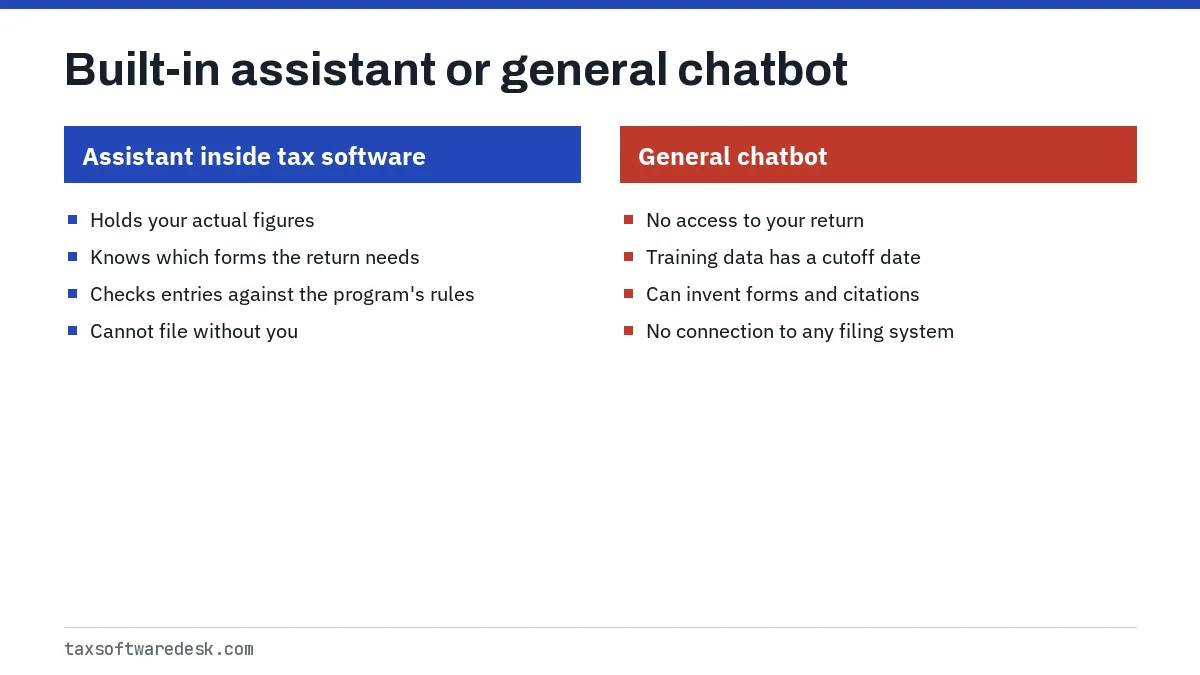
That is different from asking a general chatbot a tax question. A built-in assistant works inside a program that already holds your figures and already knows which forms your return needs. A general chatbot has none of that context, which is the source of most of the trouble covered in using ChatGPT for tax questions.
Which tax programs have AI built in?
Every major consumer program in the United States and Canada now ships some form of assistant. The table below is what each vendor calls its feature and where it sits in the product line.
| Program | Feature name | Included with |
|---|---|---|
| TurboTax | Intuit Assist | All TurboTax tiers |
| H&R Block | AI Tax Assist | Paid online products |
| TaxAct | Deduction Maximizer | All tiers |
| Wealthsimple Tax (Canada) | Willow assistant | Free, pay what you want |
Intuit describes Intuit Assist as "an AI-powered capability that provides personalized, intelligent recommendations", and says it builds a personalised checklist from what you tell it, checks the return for mistakes as you go, and looks for deductions and credits you may have missed.
The detail behind each one is on its own page: Intuit Assist in TurboTax and H&R Block AI Tax Assist.
What does AI in tax software actually do?
Four jobs, in practice, and they are worth separating because they carry different risk.
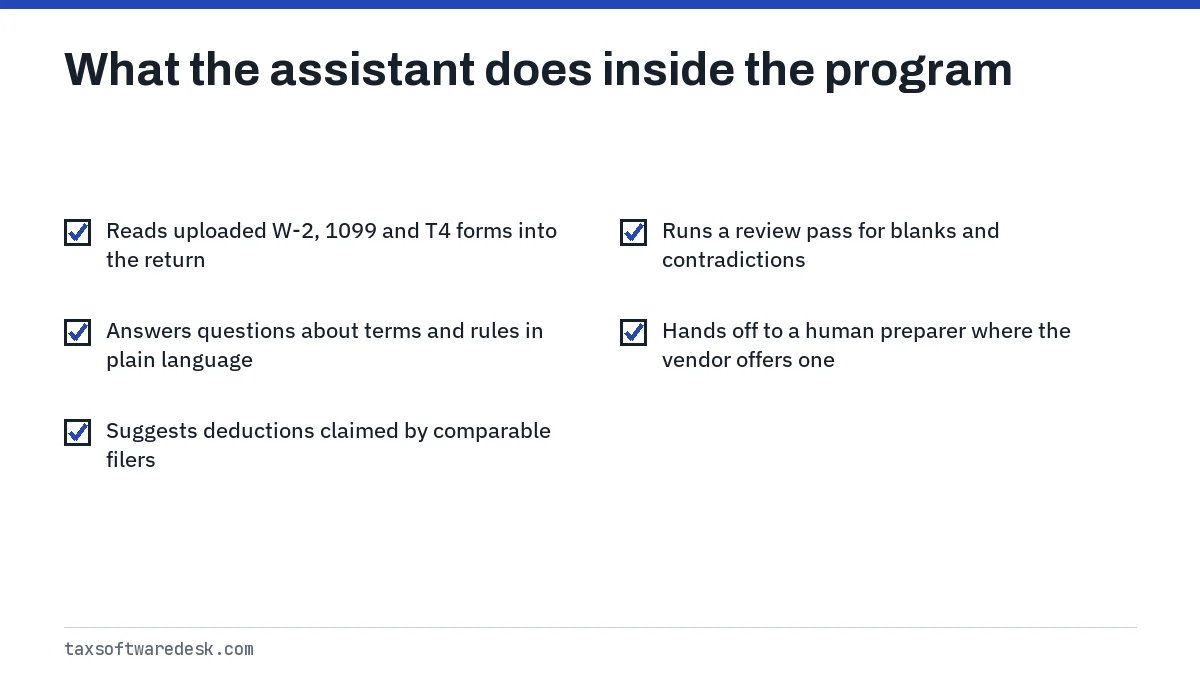
- Reading documents. The assistant scans an uploaded W-2, 1099 or T4 and writes the numbers into the return. This is the most reliable job because it is mostly optical recognition against a known form layout.
- Answering questions. You type a question and get an explanation in plain language. Useful for definitions. Weakest where the answer depends on facts the program does not hold.
- Suggesting deductions. The assistant compares your entries against what filers in similar situations claimed. A prompt, not a ruling.
- Checking the return. A review pass that flags blank fields, figures that contradict each other and entries outside normal ranges.
What AI tax software cannot do
No consumer assistant files your return by itself. You review the return and you sign it, which means you are the one making the legal representation that it is accurate.
- It cannot decide a genuinely contested question for you. Whether an expense is deductible often turns on facts the program never sees.
- It cannot see documents you did not give it. A slip left in a drawer is simply missing.
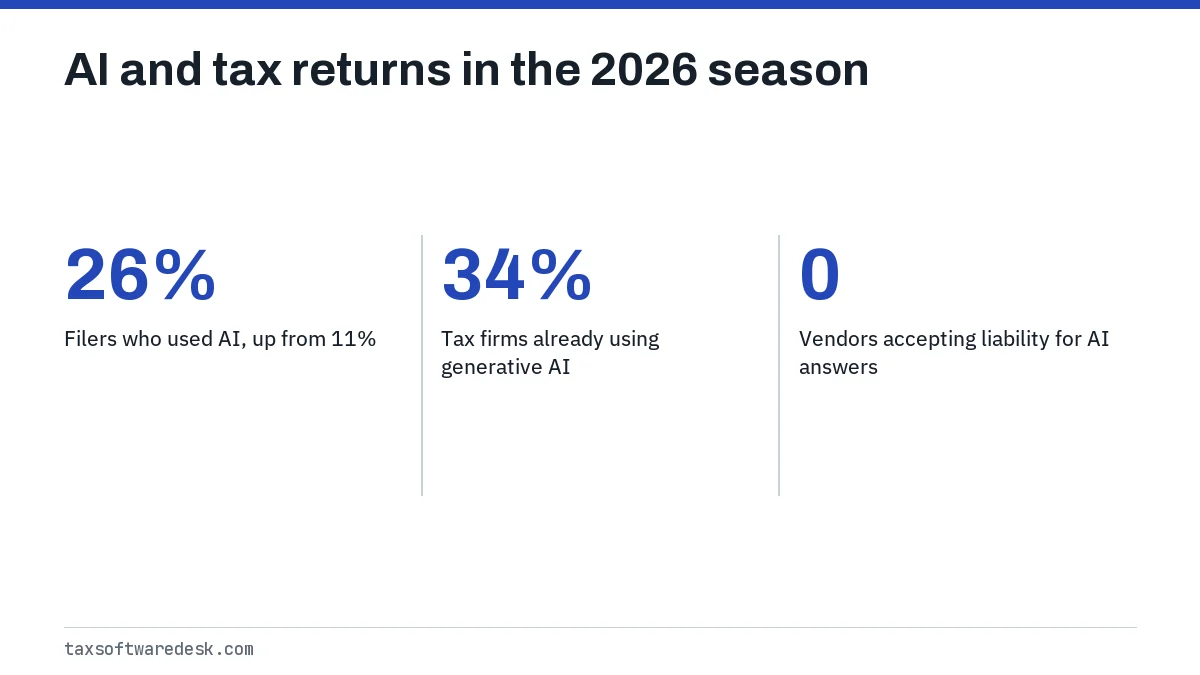
- It cannot accept liability. No vendor's AI feature comes with a promise that the AI's answer is correct.
- It cannot represent you if the return is questioned later. That needs a person.
Is AI tax software accurate?
Accurate enough for data entry, less reliable for judgement, and least reliable on rules that changed recently.
Tax professionals reviewing AI output during the 2026 season reported the same categories of error again and again: mistakes on Schedule K-1 and Form 1099 entries, state rules applied as though they matched federal rules, and changes made by the 2025 tax law missed entirely. Assistants have also been recorded inventing forms, regulations and court cases that do not exist.
The reason is structural. A model is trained on text up to a cutoff date. Tax rules change after that date. Tax year 2026 is the first year of several changes, which is exactly the material a model is least likely to have: the charitable deduction's new 0.5% floor, the replacement of the Pease limitation, and a full year of the tips, overtime, car-loan-interest and senior deductions.
Should you use AI tax software?
For a straightforward return, the assistant inside a mainstream program is a reasonable convenience, as long as you read what it produced before filing. Adoption tells you people already decided this: reporting on 2026 filing-season surveys put AI use at about 26% of filers, up from about 11% a year earlier.
Three situations where you should be more careful than the assistant is:
- Anything involving the new Schedule 1-A deductions, where the rules are one year old.
- Multi-state returns, part-year residency, or a state rule that differs from the federal one.
- Business income, K-1s, rental property or digital assets, where the form is only as good as your own records.
If price is the reason you are looking at AI features at all, compare the whole product instead, starting with choosing tax software.
Common questions
Is AI tax software accurate?
It is dependable for reading forms and arithmetic, and less dependable for judgement calls and for rules that changed in the last year or two. Reviewers during the 2026 season repeatedly found errors on K-1 and 1099 entries, on state rules that differ from federal ones, and on the 2025 law changes.
Does AI tax software file my return for me?
No. The consumer assistants prepare and check the return, but you review and sign it. That signature makes you responsible for what is on it.
Which tax software has the best AI?
TurboTax's Intuit Assist is the most deeply integrated, because Intuit has built AI into the product for several years and now runs it across every tier. H&R Block's AI Tax Assist is the closest competitor and is included with its paid online products.
Is it safe to put my tax documents into AI software?
Inside a tax program you already trusted with the same data, the assistant does not change your exposure much. Pasting the same information into a general chatbot is a different decision, because that data leaves the program and you lose control of how it is stored.
Can AI find deductions I would miss?
Sometimes. The suggestions come from patterns in what comparable filers claimed, so they are prompts to check rather than confirmations that you qualify. You still have to meet the rule.
Sources
- What is Intuit Assist? (TurboTax Support) ttlc.intuit.com
- Intuit infuses Credit Karma, TurboTax with AI agents (Accounting Today) accountingtoday.com
- Should you use AI to file your taxes? (CBS News) cbsnews.com
- I asked ChatGPT for tax help (CNBC) cnbc.com
- IRS releases tax inflation adjustments for tax year 2026 irs.gov
We check figures against these official pages. Rules change; confirm anything that affects a deadline or payment with the agency before you act.
Tell us what happened
Describe your situation and our editors will use it to improve this guide. If you leave your email, we may reply with a pointer to the right page or official contact. We never share your details.
Related guides
 Best Tax Software: Independent Guide to Choosing a Program
The best tax software is the cheapest program that supports every form your return needs. If your 2025 adjusted gross income (AGI…
Best Tax Software: Independent Guide to Choosing a Program
The best tax software is the cheapest program that supports every form your return needs. If your 2025 adjusted gross income (AGI…