
Can ChatGPT do your taxes?
Short answer
ChatGPT cannot file a tax return. It has no connection to IRS e-file or NETFILE, no access to your forms, and no way to sign anything. It can explain a term or walk you through a concept, but it gets recent rule changes, state rules and form-specific questions wrong often enough that you should verify every number it gives you before it reaches a return.
- 01Can it file a return
- No, it has no e-file connection
- 02Most common failure
- Rules that changed after its training cutoff
- 03Documented invention
- Forms, regulations and court cases that do not exist
- 04Never paste in
- SSN, SIN, bank details, full tax documents
Can ChatGPT file my tax return?
No. ChatGPT, Claude, Gemini and Copilot are all general-purpose assistants with no connection to IRS e-file or to the CRA's NETFILE service. There is no transmitter ID behind them, no way for them to sign a return, and no filing status they can report back to you.
What they can do is explain. If you want something that actually prepares and transmits a return, that is tax software, and the AI features inside those programs are covered in AI tax software.
What is ChatGPT genuinely useful for at tax time?
It is good at the parts of tax that are vocabulary rather than arithmetic.
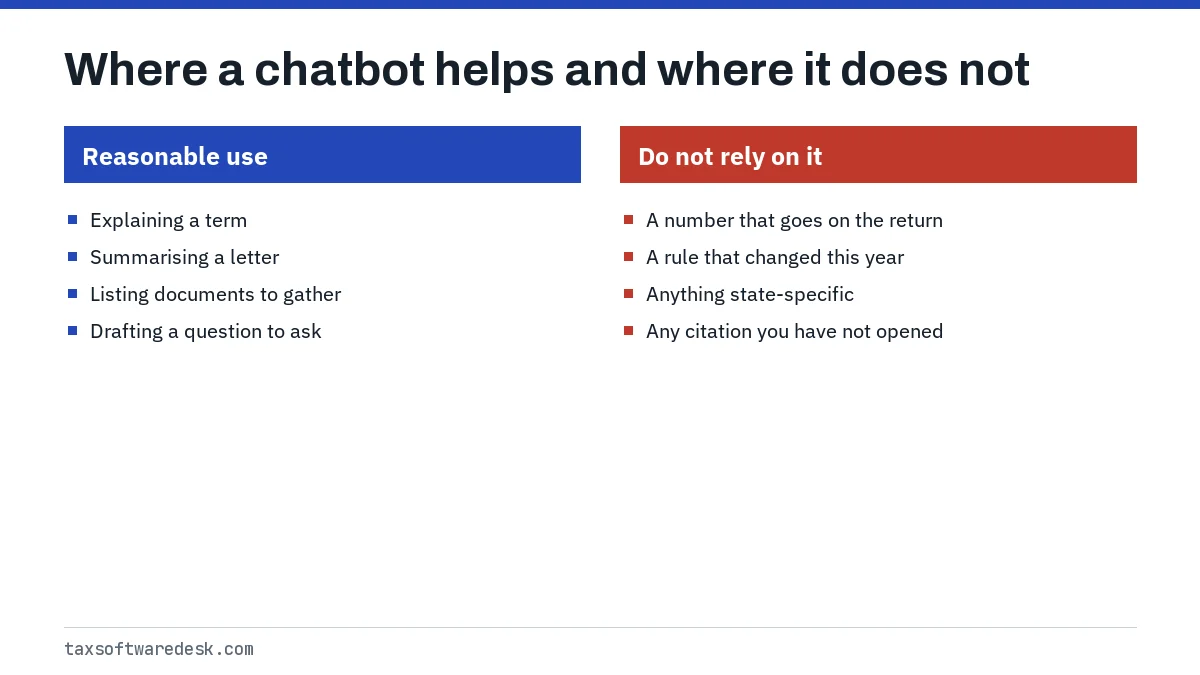
- Explaining what a term means, such as the difference between a deduction and a credit.
- Turning a letter you received into plain language so you know roughly what it is about.
- Listing the documents a situation usually needs, as a starting checklist.
- Drafting a plainly worded question you can then take to the agency or a preparer.
Notice what those have in common: none of them puts a number on a return.
Where does ChatGPT get taxes wrong?
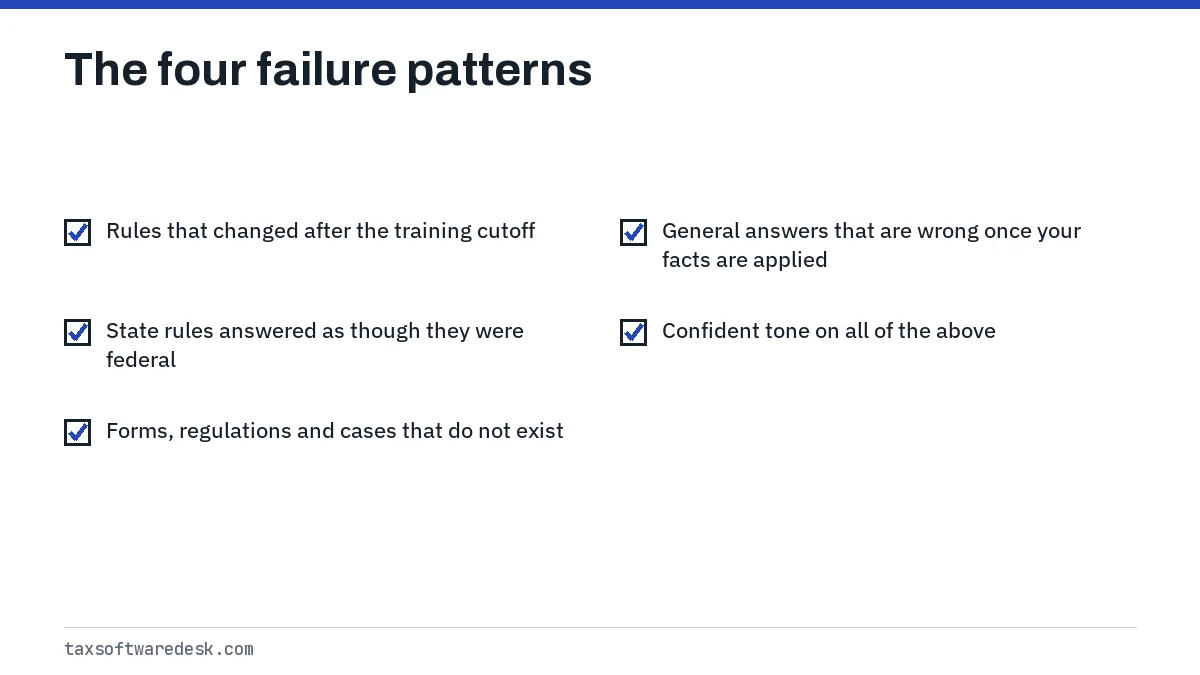
The failures are not random. They fall into four groups, and knowing them tells you exactly when to stop trusting the answer.
Rules that changed recently
A model is trained on text up to a cutoff date, so the newest rules are the ones it is least likely to have right. Tax year 2026 is unusually bad for this: it is the first year of the charitable deduction's 0.5% of AGI floor, the first year of the limitation that replaced the repealed Pease limitation, and the second year of the Schedule 1-A deductions for tips, overtime, car-loan interest and seniors.
State rules treated as federal rules
Practitioners reviewing AI answers during the 2026 season repeatedly found state rules answered as though they matched the federal treatment. They often do not.
Invented authority
Assistants have been recorded producing forms, regulations and court cases that do not exist, written in the same confident register as the correct parts of the answer. A citation from a chatbot is a thing to check, not a thing to rely on.
Answers that are right in general and wrong for you
One reported case had an AI telling a filer that cryptocurrency income under $3,000 did not need to be reported. It does. A general answer can be broadly sensible and still wrong once your own facts are applied, a gap that an assistant inside the software, such as TurboTax's Intuit Assist, is built to close.
What should you never paste into a chatbot?
Treat the chat box like a form on a site you have never used before, because in privacy terms that is what it is. Once the data leaves your device you no longer control how it is stored or who reviews it.
You can usually ask the same question with the identifying parts removed. "A single filer with $60,000 of wage income and $4,000 of tips" gets the same explanation as your real numbers would.
Who is responsible if the AI is wrong?
You are. The signature on the return is yours, and the Taxpayer Advocate Service has said plainly that taxpayers remain responsible for the accuracy of their returns and should not rely on AI chatbots alone.
No chatbot carries an accuracy guarantee for tax answers. Paid tax software sometimes does: TaxAct, for example, offers to cover the difference in tax plus penalties and interest if its own calculation is at fault. That promise is about the software's arithmetic, not about anything a chatbot told you.
A safer way to use it
- Ask the question without identifying details.
- Ask it to name the form, line or publication its answer comes from.
- Open that source yourself and read the relevant part.
- If the source does not exist or does not say what the answer claimed, discard the answer.
- Put the number into the return only after you have seen it on the official page.
That last step is the whole discipline. Whether you use a general chatbot or the AI assistant built into H&R Block, it is a way of finding where to look, not a substitute for looking.
Common questions
Can ChatGPT do my taxes?
It can explain tax concepts, but it cannot file a return. It has no connection to IRS e-file or NETFILE, cannot see your documents unless you paste them in, and cannot sign anything.
Is it safe to use ChatGPT for tax questions?
It is safe to ask general questions with identifying details removed. It is not safe to paste your SSN, SIN, bank details or complete tax slips, because that data leaves your device and you lose control of it.
Why does ChatGPT get tax rules wrong?
Its training data has a cutoff date, so recent changes are missing or half-remembered. Tax year 2026 is a bad case because several rules are new that year, including the 0.5% charitable floor and the limitation that replaced Pease.
Can I use ChatGPT to check a return my software prepared?
As a second opinion on whether something looks odd, yes. As an authority on whether an entry is correct, no. Verify anything it flags against the form instructions before you change the return.
Does the IRS know if I used AI to prepare my return?
There is no box on the return for it, and no requirement to disclose it. It also makes no difference to your responsibility: the return is yours either way.
Sources
- Should you use AI to file your taxes? Experts warn it can lead to costly mistakes (CBS News) cbsnews.com
- I asked ChatGPT for tax help, experts say I fell into a classic trap (CNBC) cnbc.com
- What AI gets right, and very wrong, about taxes (NerdWallet) nerdwallet.com
- Using an AI like ChatGPT to file your taxes: data privacy risk (McAfee) mcafee.com
- IRS releases tax inflation adjustments for tax year 2026 irs.gov
We check figures against these official pages. Rules change; confirm anything that affects a deadline or payment with the agency before you act.
Tell us what happened
Describe your situation and our editors will use it to improve this guide. If you leave your email, we may reply with a pointer to the right page or official contact. We never share your details.
Related guides
 Best Tax Software: Independent Guide to Choosing a Program
The best tax software is the cheapest program that supports every form your return needs. If your 2025 adjusted gross income (AGI…
Best Tax Software: Independent Guide to Choosing a Program
The best tax software is the cheapest program that supports every form your return needs. If your 2025 adjusted gross income (AGI…